Tuesday, 17 January 2012

Termites the original mud builders!!


Termites are amazing little creatures, when I first moved to Zimbabwe I was amazed to see these mounds that appeared all over the horizon, sculptural and intricate in their own right, these are the original mud builders!! In areas where no clay is found people building mud huts in zimbabwe will use the termite mounds by grinding it up and adding water, then making bricks from this, the result is very strong. I chose not to use this method as I would prefer not to destroy termites homes, after all of that hard work! Unfortunately when building your own home termites can become a huge problem, eating through structural wood. I really don't want to use any harmful chemicals for treating the wood, here the only options are pressure treated poles with Cresote or CCA. I would like to treat wood myself with something less harmful such as borax.


I have had some good suggestions, help and advice from joining a permaculture forum http://www.permies.com , which includes a natural building forum, there are lots of interesting ideas and topics raised. I posted a link to my blog to see if anyone could help and a discussion on termites and wood borers has started up, please have a look if you are interested or have any ideas http://www.permies.com/t/11974/green-building/cob-blog-please-have-look

Friday, 13 January 2012

Details, details...

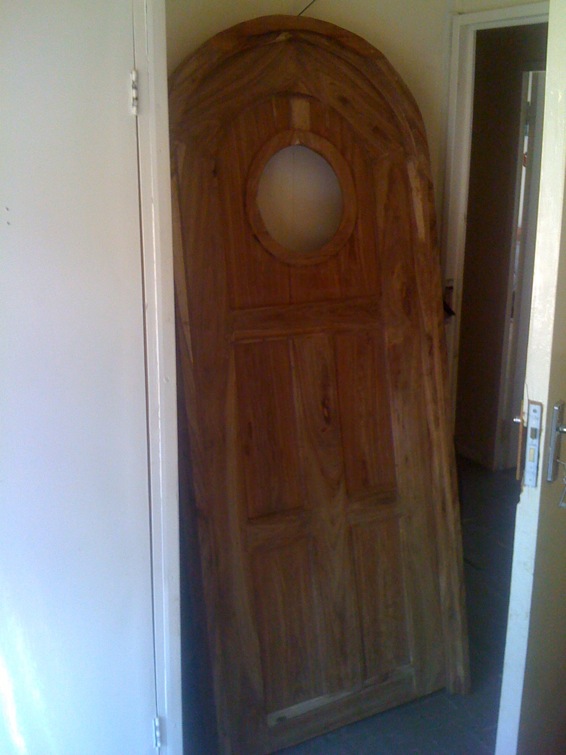
I drew up the design for this door, which will be the front door. A local carpenter who uses wood from the forestry commission, which is the most sustainable source of wood here at the moment. The wood used is Mukwa. He did a great job, I'm really happy with this, a window pane will be fitted in the circular hole. I love arches and I am keen to have mainly arched doors and doorways in the house, this also reduces the need for lintels. The back door will be rectangular with a lintel as I have some old railway sleepers which look beautiful as lintels.

Any wood which is cut and used in the house, we are replacing by planting more trees which I have grown from seed on our land.

Saturday, 7 January 2012

Laying the foundations.

For the foundations we have been using stones which were collected close to the land with a scotch cart. The stones vary in size and shape, larger heavier stones were used for the first layer. Over lapping is as important as in brick work, to ensure no continuous cracks form.
The mortar used between the rocks is the same as the cob mix, but with 15 percent lime added. So to mix this we needed to wear boots as lime is very corrosive. The lime hardens the mortar.
There is no bore hole on the land, so I delivered water each day emptying it into an old bath.


Sunday, 18 December 2011

Site selected, marked and pegged, get digging!

The site was selected, Misheck pegged out the building according to the design I had drawn up (which I will post soon!) and we were ready to start digging. It's quite a huge job, I wanted to make the foundations 1m deep and 60 cms wide to make sure the weight of the roof could be supported by the walls.

It's great to start seeing the shape and design come to life! The sand that is dug out of the foundations will be used in the cob mix.


Now the foundations have been dug, the earth below is rammed to compact the earth below.


I've included the site of our future home on the 'Location' link below for you to have a look!

Thursday, 10 November 2011

Getting started

We bought a wooden shed to store all the tools and materials whilst we are building. I made a stone floor with a cob/lime mortar. It gave me a chance to see how strong the mix with the lime was.

For digging and building the foundations for the house we decided to employ a local builder and 2 helpers, to dig the foundations ourselves would take a long time and we wanted the foundations done before the rains start! Once the foundations are done, I plan to build the cob walls myself.

Looking at possible sites to build with Misheck who will be building the foundations


Yabani delivering rocks from nearby in his scotch cart


Clearing the site, we chose an area where we didn't need to cut down any trees, with a good view, drainage is good, we then cleared a road going around any large trees to have access to the site.

Sunday, 30 October 2011

Natural building course South Africa

I took part in a week long natural building course in Berg-En-Dal eco-village in South Africa, I had an amazing time, learnt a lot and felt it gave me the knowledge and support to now start building our family home. 


here is an overview of what was taught on the course:

PERMACULTURE ORIENTATION
Zone Zero (home) and Zone One (surrounding garden) integration and climate mitigation Green technology introduction.
BUILDING SKILLS
-Basic site layout and measuring
-Passive solar design
-Foundations
-Walls
-Plastering
-Openings
MATERIALS
-Cob
-Mud brick /Adobe
-Rammed earth
-Straw bale
-Rock
-Compressed earth block
-Environmental and social impact of building
making a stone and cob/lime mortar foundation


Building an adobe brick wall

For anyone who is interested in natural building or building your own home, I feel a building course is really useful to do before you start. For those of you living in southern africa I would recommend the course at Berg-En-Dal eco-village, the link for their website is below:      

Tuesday, 25 October 2011

Testing, Testing 1 2 3 4 5 6 7 8 9 10 11 12

The first thing I had to do was test the soil on and around our plot to see if it was suitable for building with cob. A local carpenter made brick moulds to my specifications from wood from forestry land. We employed a young man from our village to collect different sands and clay in his scotch cart from areas close by. Cob needs to have the right proportions of clay and sand, we found there was a very good clay deposit just below our plot, the sand on the plot is very fine so river sand was also collected as a good particle range is needed. Straw is essential for tensile strength in the mix, wheat is supposed to be the best. There is no farming of wheat in our area so for the tests I used wild grass that had been baled once it had dispersed it's seeds.
I made 12 mixes, using different proportions of sand and clay, the most fun method of mixing cob is on a  tarp with your feet. All the sand water and clay are mixed with your feet and then by rolling the tarp in different directions to make sure everything is well mixed, the straw is added last.
"You know your job, you dance like an elephant" 'Yabani' on seeing me mixing cob with my feet!

The next step was to make bricks using the brick moulds, this is only for testing the strength of the mix as cob is applied wet to the foundation/stem wall. I made the bricks numbering each mix and small balls to test the compressive strength.


After a week of drying(and turning every couple of days) the bricks were ready to test. To do this I dropped the bricks on a hard surface to see how and if they broke! Most of them crack at least a bit, but I found the perfect mix!! 2 1/2 buckets of pit sand(dug from the plot) 1 1/2 buckets of river sand and 1 bucket of clay, plus the straw makes a very strong mix, so I am very pleased!