Monday, 3 February 2014

Applying Permaculture to the land


For the past couple of  months I have mainly been taking a break from the construction to start applying what I have learnt to the land. It's been really exciting to see everything take shape.

The bricks are all finished, the last ones, curved for the corners...

...with bottles inside


...found objects that will make great coat hooks!
My neighbour kindly gave me heirloom seeds for groundnuts. I decided to plant them in a small field, along with some cowpeas , sunflowers, various melons, pumpkins, gourds(help with ground cover) and some rosela. Intercropped with Moringa and sebania trees. These trees along with the groundnuts and cowpeas fix nitrogen into the soil. 

I took part in an oyster mushroom growing workshop in Bulawayo, and grew some at home, very exciting to see them grow. 


Making a simple solar drier to drier for mushrooms, fruit etc 


The stem wall has been coming up and I will start working on the building again now.


We dug a swale on contour, this catches rainwater and keeps it on the land rather than running off and then planted the seeds below.

making seed balls with clay and a variety of seeds to throw onto the land.

shelling groundnuts

Both sides of the field are covered with mulch, this keeps the moisture in the ground, this side is leaves...

...and this side straw


Planting fruit trees where grey water will be running out of the shower. To protect from grazing animals Yabani made fences from branches as is traditionally done here. 
burying an unglazed clay pot for dry times, the water seeps out slowly.

a wine bottle filled with water and buried seeps water out slowly and directly to the roots. 
Flame lillies are out everywhere

making a pit bed, kitchen scraps are put in a hole in the centre to become compost that directly feeds the banana and pawpaw trees planted around it. 


Our first tank for rainwater collection

Moringa trees planted amongst the groundnuts 


It's very satisfying to watch everything grow, there will be challenges ahead though,  in the next month or so is when the elephants will start entering the fields. For now I will get back to building, I need to finish the stem wall, make a termite barrier and then start laying bricks. 

Thursday, 17 October 2013

The Mud Brick Factory

It's been a long time since I have had the time to sit down and try and write and up load photos of what I have been doing. I am building every single day, it's very very hot but the building process is coming along nicely, so let the photos do the talking...

Friends and family have been visiting and helping out, here my parents are having a go at mud dancing

Taking a moment to admire the many beautfiul butterflies that flock to the moisture of the mud dancing 


preparing the tree nursery with oliver and his friends, we want to plant the trees in the rainy season on the plot

Oliver has been helping out

making his own house deisgn's 

So  I have finished the foundations and I'm  trying to get all the bricks finished before the rains,  getting there!! 


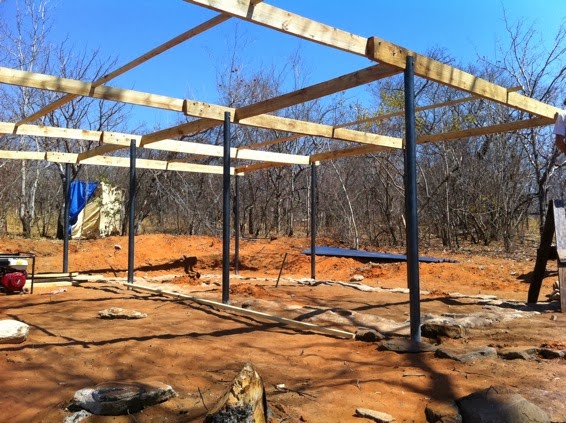
Putting up the roof!!

 We spent a weekend a couple of weeks ago building the roof on poles so that the foundations are protected and I can keep building even when it starts to rain, so I am very happy!! 


This amazing contraption allowed us to make holes for the poles without digging, just twist in wet sand and it goes in like a cork screw, a bit more effort but better than digging holes!! 


Collecting water at the village borehole, the hand pump is hard work! 

The roof coming up

Yabani making a quick ladder from some sticks, amazing

Tadaaaaa!!

I couldn't have done this without the help of my husband Brent, Roy, Misheck and Yabani, it was real team-work and it came together beautifully, thanks so much!! 


The roof covers the house and also has a verandah, guttering is to come so we can collect the precious rain!! 

My bricks are safe under the verandah's roof,  so I should be able to sleep soundly once the rains start!!

Wednesday, 28 August 2013

'The problem is the solution'

I have been busy building and having little time to write. I have had to re-think what I am doing with the building project completely.

The structure I have been building in cob I have left for now, the termites have gone after removing the black plastic from the walls. I have left this structure for now and still plan to use it, either finish building it as it is or have half walls with a pole roof structure over it. We will see maybe next year what to do with it.
levelling the ground, this took quite some time!! 

So I have levelled the ground, dug the trench and have been building the stone foundation for a small two roomed structure to have a place to stay as soon as possible. I am making sun-dried mud bricks with no straw. I have been playing around with the mix as it is not as strong with no straw. I have found that after all that, termite mound clay is way better than the clay I have been using in the cob! I didn't want to do this as I didn't like the idea of destroying a termites home. It seems that as long as you don't take away everything, leaving the colony and the queen, they are fine and they rebuild. I didn't decide to use this because of vengeance, but the smooth nature of the clay that requires little soaking shows why people have been using this as a building material for so long here.
marking and pegging the foundations

The fact that natural building techniques are being replaced more and more with modern materials which are less comfortable, and so much more expensive both financially and for the environment, comes a lot from the idea that it is a poor peoples building technique. So the style of the house I am building now, is using similar techniques to the traditional method, but with the style of house that is considered more modern.

I have had to make a lot of test bricks to see what is the strongest, I have had to use more sand to stop the clay from cracking, which is a common problem with this clay. I have found the best mix to be 1 1/2 clay, 2 pit sand straight from the ground below, and 1 1/2 river sand.

Another lesson learnt is to accept some help, so yabani has been coming to help me a few mornings a week, which definitely helps things move faster!

I will post more recent photos soon, I leave you with a few photos of an amazing community I visited with my family a few months ago. This is a whole group of villages in a communal area in the chimanimani mountains, who have been practising permaculture for 20 years!! It's truly inspiring, Julius Piti showed us around and I was totally taken aback to see how successful this was, flourishing. Something to aspire too!! Of course being at the base of a mountain range is not the same as being in the Kalahari sands, but it's even more of a challenge!!


Monday, 15 July 2013

Permaculture Design Course South Africa


As promised I am posting about what I have been doing the past few months since the termites moved in!

I think an important thing to mention is that what I am doing is not just about building a house. I have been focusing this blog on the process of building, sometimes it’s necessary to go a bit deeper though…So no I’m not just building a house, I’m building a lifestyle that is based on the ethics and principles of permaculture. When I first started down this path I wasn’t sure if I should first do a natural building course or a permaculture design course. I thought having a home was the first step so I did the building course first. I have just been to South Africa to do the full permaculture design course, and I really think I should have done that first!!


Here is a short description of what permaculture is, many people have heard the term but aren’t really sure what it is:

“Permaculture is the conscious design of human living environments that are reflections of the ecological principle that underlies nature. It is the harmonious
integration of landscape and people providing their food, energy, shelter and other material and non-material needs in a sustainable way. Permaculture
design is a system of assembling conceptual, material, and strategic components in a pattern which functions to benefit life in all its forms.”

The course was amazing, the teachers Tahir Cooper and Alex Kruger where truly inspirational. As were the course participants. I had read a lot about permaculture and done an introduction to permaculture course but I don’t think I really understood it until now. I think if I had done this first I would have really chosen the most appropriate natural building method for this area rather than just what I loved the most!! Doing the course in a place that demonstrates a community of people living together and meeting their needs, without harming their environment, even better,  healing their environment, is truly the best teaching method. 
Permaculture makes you think about everything in a wholistic way, rather than living a linear life of consumerism and waste. 

Permaculture in it’s most basic form is about sharing so that everyone and everything can have what they need today and in the future. If we consider every action we take and the effects it has, will people and the environment be the same in 7 generations if I….. (fill in the blank)? I have found it a real wake up call!! If every decision we make has an underlying universal ethics of people care, earth care and fair share, we will always be making the right decision!! It means taking action now, and it’s not about paying off carbon credits or giving 10 dollars to WWF and thinking this is all we have to do to secure a bright future for the world. The world we are wilfully destroying, the world which we depend on for our every need!!! 

I feel excited, hopeful and motivated after doing the course, it’s not about doom and gloom, but about solutions. In many ways yes it’s easier to move towards a simpler life where I am, but it is also one of the most difficult. The challenges that face us in our context here are huge, no water, sandy soil which is hard to grow food in, the rainy season only lasted 2 and a half months this year, climate change is only going to make this worse, Elephants and other animals roam in the area where people grow food. A huge mine is now underway just down the road which will destroy the environment and could seriously affect the water in the aquifer in this area that both people and wildlife depend on. And for what? so we can continue to have an  unlimited source of electricity, dependent on non-renewable resources. Would this happen if an ethical framework had been the starting point for decision makers?

I am now moving forward with the building of my home, and a life with positive impact! 

More mud dancing coming soon!

(Thanks Yvonne for the photos!!)